What Small Businesses Actually Search About Their Website (And the Answers They Need)
If you run a small business, chances are you’ve typed at least one of these into Google at 11pm on a Tuesday. We know because we see the search data, and the same questions come up over and over again. The good news is that none of them have complicated answers. The bad news is that a lot of agencies give you complicated answers anyway, because confusion is profitable.
So here’s the straight version. No jargon, no sales pitch disguised as advice. Just the answers to the questions that real business owners are actually asking.
Do I Still Need a Website in 2026?
Short answer: yes. Longer answer: absolutely, and more than ever.
Around 83% of small businesses now have a website, up from 64% in 2018. That’s not because the internet is trendy — it’s because businesses without websites are losing ground to those that have them. The 17% still without one mostly say it’s “not relevant” to their business. With respect, that’s almost never true.
Your website is the one piece of digital real estate you actually own. Social media platforms change their algorithms on a whim, marketplace listings are controlled by someone else’s rules, and a Facebook page gives you about as much credibility as a business card drawn in crayon. A website works for you 24 hours a day, doesn’t call in sick, and doesn’t require you to dance on TikTok to get seen.
How Much Should a Small Business Website Cost?
This is the big one, and the honest answer is: it depends, but probably less than you think for a good one, and definitely more than you’d expect for a bad one.
A professionally built, well-optimised small business website should cost somewhere between £500 and £3,000 as a one-off build, or £50–£150 per month for a managed service that includes hosting, maintenance, and updates. If someone is quoting you £10,000+ for a five-page brochure site, they’re either building something bespoke and complex, or they’re having a laugh.
The real cost isn’t what you pay upfront. It’s what a bad website costs you in lost enquiries, poor Google rankings, and the slow bleed of potential customers who visited, waited too long for it to load, and left. A cheap website that doesn’t work is the most expensive website you’ll ever own.
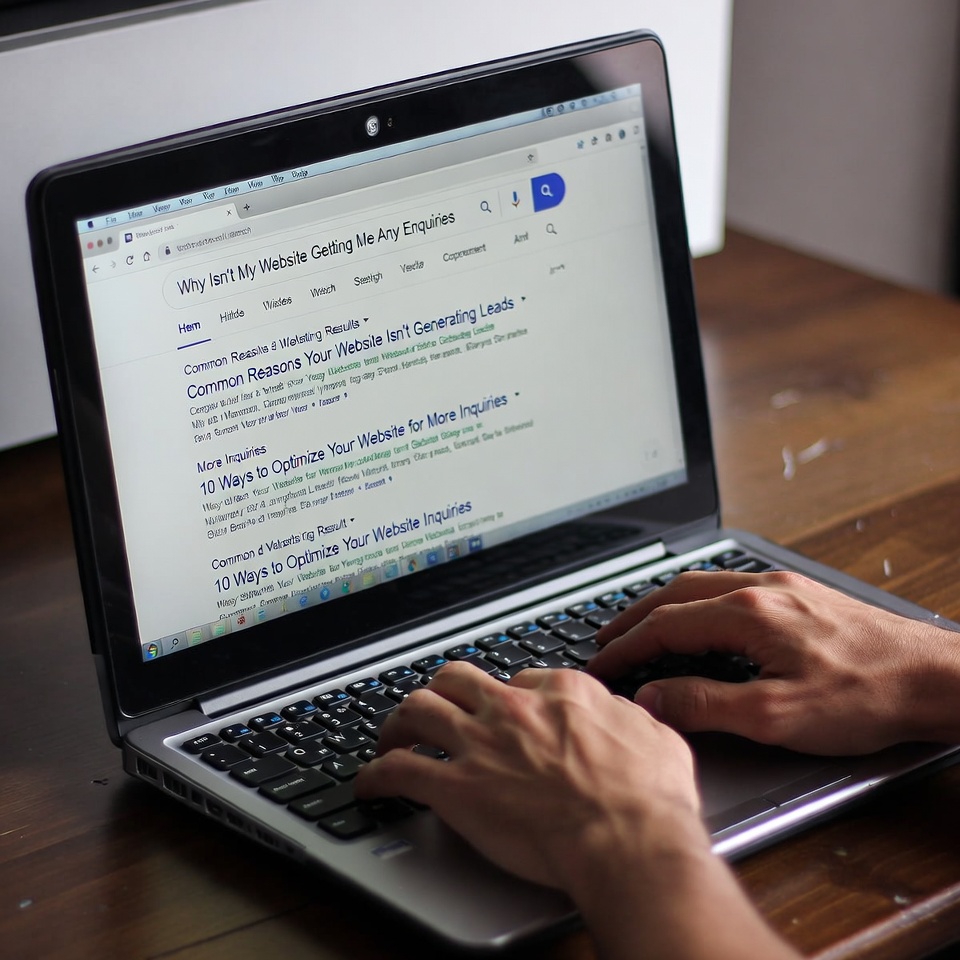
Why Isn’t My Website Getting Me Any Enquiries?
This is the question that keeps small business owners up at night, and it usually boils down to one or more of three things.
First, nobody can find it. If your site isn’t showing up in Google searches for the services you offer in the areas you serve, you’re essentially invisible. That’s an SEO problem, and it’s fixable.
Second, people find it but leave immediately. If your site takes more than three seconds to load on a phone, roughly half your visitors will bounce before they see a single word. That’s a performance problem, also fixable.
Third, people visit but don’t know what to do next. If there’s no clear call to action — no obvious phone number, no contact form above the fold, no reason to get in touch right now — visitors will browse politely and then vanish. That’s a design and messaging problem. You guessed it: fixable.
The common thread here is that your website probably isn’t broken in some mysterious way. It just needs someone to diagnose the specific problem and address it, rather than throwing a redesign at a performance issue or adding blog posts to a site that can’t even load properly.
What’s the Deal with SEO? Is It Worth Paying For?
SEO — search engine optimisation — is the process of making your website more visible in Google search results. Forty percent of small businesses with a website say SEO is their top source of leads. That’s not a marketing claim from an SEO agency. That’s what business owners themselves are reporting.
The catch is that SEO has a reputation problem, partly deserved, because a lot of agencies sell it as a mysterious monthly retainer with vague deliverables. We’ll cover this in more depth in a separate post, but the short version is: foundational SEO — the technical stuff, the on-page optimisation, the local signals — should be baked into your website from day one, not bolted on as an expensive afterthought.
Should I Just Use Wix or Squarespace?
You can. These platforms have gotten genuinely better, and for some businesses they’re a perfectly reasonable starting point. But “reasonable starting point” and “best long-term solution” aren’t the same thing.
DIY builders trade flexibility for convenience. They’re great until you need something they don’t offer, at which point you’re stuck. The bigger issue is performance: most template sites carry significant code bloat that slows them down, and speed directly impacts both your Google rankings and your conversion rate. If you’re a sole trader testing the waters, a builder might be fine. If you’re a serious business that depends on web enquiries, you’re going to outgrow it.
How Do I Know If My Website Is Actually Any Good?
There are concrete ways to measure this, and none of them require a degree in computer science.
Run your URL through Google’s PageSpeed Insights tool. It’s free, and it’ll give you a score out of 100 for both mobile and desktop performance. Anything below 50 on mobile is genuinely hurting your business. Check Google Search Console to see what search terms are bringing people to your site, and whether your pages are being indexed properly. Look at your Google Analytics to see how many visitors you’re getting, how long they’re staying, and where they’re dropping off.
If any of those tools make your stomach drop, that’s actually good news — it means there’s a clear problem with a clear solution. The businesses in real trouble are the ones who never check.
The Bottom Line
Small business owners are practical people asking practical questions. The answers don’t need to be complicated. You need a website. It needs to load fast. It needs to show up when people search for what you do. And it needs to make it obvious how to get in touch. Everything else is detail.
If your current website isn’t doing those four things, it’s not serving your business — it’s just occupying a URL.